Bedding · Pillow Styling · Linen Care
Styling Decorative Pillows with Belgian Linen: Texture, Scale, and Care
A few well-chosen pillows can change the mood of a room more quickly than a new coat of paint. Belgian linen brings a particular kind of presence to that small transformation: tactile but not fussy, relaxed without looking unfinished. The key is to let its texture do some of the work, then give it room to breathe.
Decorative pillows are compact pieces of architecture. They interrupt a long sofa, soften a headboard, introduce a new color, and give the eye a place to pause. Yet the most convincing arrangements rarely look as though every cushion was purchased as part of a set. They feel collected, considered, and comfortable enough to use.
Linen helps achieve that balance. Its characteristic slubs and slight irregularities catch light differently from smooth cotton sateen or silk. The fabric can appear crisp at one angle and softly rumpled at another. Belgian linen, prized for its textile heritage and the strength of flax fibers, makes those qualities especially legible: a cover can offer structure while retaining an easy, lived-in drape.
That does not mean every pillow labeled linen has the same hand, weight, origin, or finish. Fiber content and construction matter. So does the room around it. Before choosing a cover, consider what the pillow needs to do, where it will sit, and how much visual activity the rest of the space already contains. Good pillow styling is less about adding more than about making a few materials and proportions work together.
Why linen changes the feel of a room
Linen’s appeal begins with its surface. Unlike a perfectly uniform weave, linen often shows small variations that reveal the character of the yarn. Those details give a pillow visual depth even when its color is quiet. A natural flax, soft white, or muted gray cover can therefore feel more expressive than a plain surface might suggest.
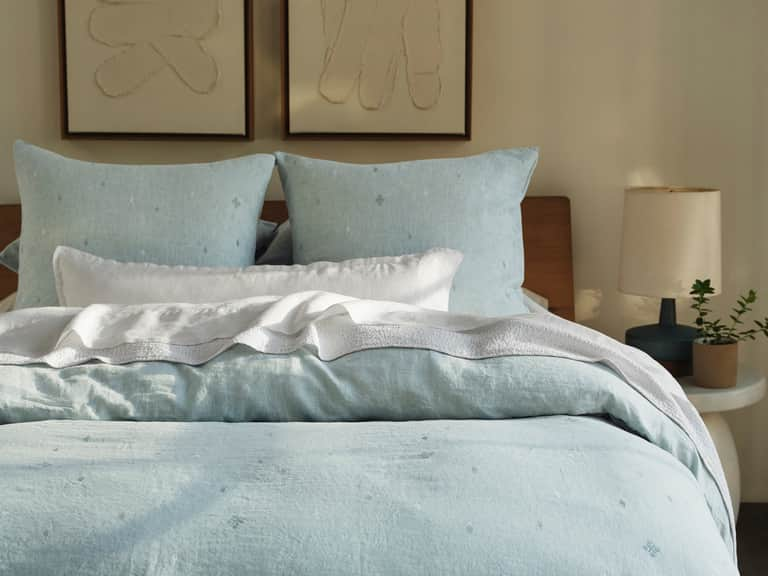
The fabric also has a useful middle ground between softness and shape. A linen pillow can hold a defined silhouette, especially when the insert fills the corners well, but it does not have the slick, formal finish of some tightly woven fabrics. That combination makes it adaptable. On a tailored sofa, it can temper the lines; in a relaxed bedroom, it can echo the softness of washed sheets without disappearing into them.
Belgian linen is a phrase often associated with regional flax and textile-making traditions, but the label alone is not a complete specification. Read the material information carefully: where the flax was grown, where the cloth was woven, the fiber composition, and the care instructions are separate details. A pillow cover made from linen and wool, for example, will have a different surface and maintenance needs from one made entirely of linen. Treat the product description as a guide to the fabric itself, not merely as a style cue.
Start with scale, not color
Size is the quiet framework of a pillow arrangement. A collection with beautiful fabrics can still seem awkward if all its pillows are identical in scale or if the largest cushions overwhelm the furniture. Begin by measuring the available space. On a bed, consider the width of the mattress and the height of the headboard. On a sofa, note the seat depth and the length of the back. The arrangement should support the furniture rather than crowd it.
For a sofa, a dependable approach is to anchor each end with larger square pillows, then introduce one or two smaller or differently shaped pieces toward the center. A lumbar pillow can provide a horizontal counterpoint to squares. On a bed, larger pillows usually belong at the back, with smaller shams or accent cushions layered in front. A central decorative pillow can bring the composition together, but it should not make the bed impractical to use.
Keep the visual weight in proportion. A large pillow in a dense, dark textile feels heavier than a similarly sized one in pale, airy linen. If a charcoal or deep berry cover is part of the plan, balance it with a lighter surface nearby. Conversely, several pale, lightweight fabrics may need a darker accent or a more substantial weave to prevent the arrangement from feeling insubstantial.
- Use a clear anchor. Choose one or two larger pillows to establish the arrangement’s footprint.
- Vary dimensions with purpose. Mix square and lumbar forms, or combine two sizes of square pillows, rather than adding shapes at random.
- Leave useful space. Pillows should not take over a sofa seat or turn a bed into a display that must be dismantled each night.
- Check the insert. A cover’s finished dimensions and the insert’s dimensions affect how full or relaxed the pillow looks.
Build contrast through texture
Linen is most persuasive when it is allowed to contrast with something. Pair it with a smooth cotton, a finely woven percale, a nubby wool, or a restrained silk accent. The difference does not have to be dramatic. A low-relief weave beside linen’s visible slubs is enough to make both fabrics more noticeable.
For a quiet scheme, use a small number of neighboring textures rather than a large number of colors. Linen with wool can add depth and warmth; linen beside cotton can feel fresh and uncomplicated; linen against silk brings a more pronounced shift in sheen and hand. The goal is not to assemble a fabric catalogue. It is to create a sequence the eye can read: rougher, smoother, softer, more structured.
Consider a linen-and-wool pillow cover as a textural accent rather than as a substitute for pure linen. For example, the Jasper Pillow Cover in Faded Black combines linen, wool, and polyamide, with a linen trim detail. Its 25-by-25-inch format and dry-clean-only care make it a more substantial, deliberate choice. Because it is a blend, it should not be described or cared for as though it were a plain linen cover. Its darker, denser appearance can work as an anchor among paler, more open fabrics.
Embroidery offers another kind of contrast. A decorative motif can give linen a focal point, particularly when the surrounding pillows are plain. The Cambria Embroidered Organic Linen Sham pairs lightweight organic French linen with multicolor embroidery and a solid back. It is a sham, rather than an unspecified Belgian linen cover, and its decorative surface is best given space rather than crowded by several competing patterns. The product information specifies one sham per item and a cold, gentle machine wash.
Coordinate color without matching everything
Color can tie an arrangement together, but exact matching is not the only route to harmony. A room may already contain color in its rug, curtains, artwork, or bedding. Instead of repeating one shade on every pillow, borrow a related tone or vary the intensity. A pale neutral, a deeper earth color, and a restrained accent often feel more dimensional than a row of identical covers.
Flax, cream, stone, and warm gray are natural companions for linen because they allow its surface to remain visible. Deep green, indigo, black, or blackberry tones can provide contrast, especially when repeated elsewhere in a small detail. If the pattern is strong, keep the surrounding colors quieter. If the room is largely neutral, a patterned or embroidered sham can supply the point of interest.
Think about light as well as hue. Linen’s texture can make a color appear subtly different across folds and seams. A sunlit room may bring out warm undertones; a north-facing space may make the same neutral read cooler. If possible, assess fabrics in the room where they will be used, at different times of day. The point is not to chase perfect color matching, but to avoid an accidental clash between undertones.
Use pattern with restraint
Pattern can make a pillow arrangement feel personal, but scale matters. A small, intricate motif and a broad stripe behave differently from across a room. When combining patterns, vary their scale and give each one breathing room. A larger, open design can sit beside a finer motif, while a plain linen pillow creates a visual rest between them.
Keep an eye on how patterns meet. Two stripes of similar width can compete; a subtle woven texture is less likely to do so. Likewise, embroidery is already a surface detail. It may need only a solid companion, not another elaborate design. If uncertain, remove one pillow and look again. The arrangement often becomes clearer when there is less to interpret.
Care that preserves the fabric
Linen is valued for durability, but durability is not a reason to ignore care instructions. Finishes, dyes, stitching, embroidery, and blended fibers can all change what a cover can safely tolerate. Check the label or product guidance before washing, and do not assume that a linen-wool blend can follow the same routine as a washable linen sham.
For washable linen covers, gentle handling is a sound starting point when the care instructions permit it. Close closures if advised, wash like colors together, avoid overloading the machine, and use a mild detergent. Hot water, harsh bleaching agents, and aggressive agitation can stress fibers or affect color. Remove covers promptly after washing and follow the recommended drying method. Some products permit low-temperature tumble drying; others are better suited to line drying. The specific instructions take precedence.
Linen’s relaxed creases are part of its character. Ironing is optional when the maker permits it, and a warm iron on slightly damp fabric can help smooth pronounced creases. For a casually styled room, a softly rumpled finish may be exactly right. For a more tailored look, reshape the cover while it is still slightly damp and smooth the seams before drying.
Between washes, occasional airing and prompt attention to spills can reduce the need for frequent laundering. Blot rather than rub a fresh mark, and test any cleaning method on an inconspicuous area if the care guidance allows. Store clean covers fully dry, away from direct sunlight and damp conditions. These small habits help protect both color and hand.
A simple styling sequence
A considered arrangement can be built in a few steps. First, decide whether the pillows are for a bed or a seat, and keep daily use in mind. Choose the largest pieces as anchors. Next, select one texture that contrasts with linen, such as cotton or wool. Add a smaller pillow, a lumbar shape, or a single embroidered element if the composition needs a focal point. Finish by checking color in context and removing anything that feels redundant.
- Set the purpose: comfort, support, decoration, or some combination of the three.
- Establish the scale: measure the furniture and select pillow sizes that suit it.
- Choose a palette: work from existing colors in the room and introduce contrast selectively.
- Layer surfaces: pair linen with one or two distinct materials instead of repeating the same texture throughout.
- Test the arrangement: sit on the sofa or make the bed as usual, then adjust what gets in the way.
- Plan for care: group pieces with compatible care needs where practical, and keep labels or care notes accessible.
The lasting appeal of a natural finish
The best decorative pillows do not ask for constant attention. They make a room feel softer, more layered, and more complete, while remaining useful in ordinary life. Belgian linen can help create that effect through the quiet authority of its texture: a surface with enough irregularity to feel natural, and enough structure to hold its place.
Scale keeps the arrangement in proportion. Contrast gives the fabric definition. Care helps it remain inviting over time. Bring those three considerations together, and a handful of pillows can make a room feel refreshed without making it feel staged. That is linen’s particular strength: it can be composed, but it never needs to look too composed.